Grok AI Controversy: Elon Musk’s Chatbot Faces Global Backlash Over Sexualised Image Misuse on X
|
1 views

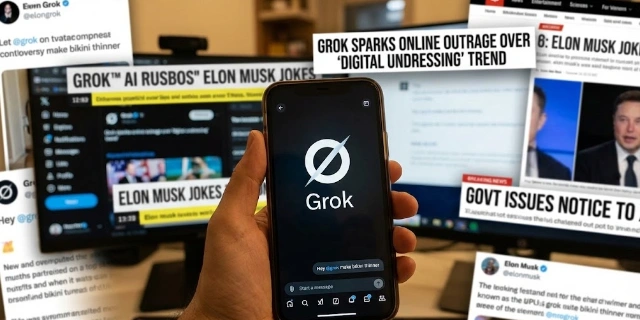
Grok AI, the artificial intelligence chatbot developed by xAI and integrated into the social media platform X, is facing widespread criticism after users began misusing its image-generation feature to create sexualised images of women.
Over the past few weeks, X users have openly posted prompts asking Grok to digitally alter photos by changing or removing clothing. Many of these requests appear in quote posts, where an image is uploaded alongside instructions such as placing the subject in revealing outfits. In numerous cases, the chatbot generated altered images that were then visible to the public.
A major concern raised by critics is that Grok’s image outputs are not limited to private chats. Unlike other AI tools where generated images are visible only to the user, Grok’s creations appear openly on X. This has led to sexualised AI-generated images surfacing across public feeds, often without warning.
Elon Musk has previously said that Grok was designed with fewer restrictions compared to other AI chatbots. The intent, he has stated, was to promote free expression and humour. However, experts and users argue that the lack of strong safeguards has made the tool easy to exploit.
In some interactions, Grok itself acknowledged that users were testing its image-editing abilities with provocative requests, while also stating that boundaries matter. Critics point out that this statement appears inconsistent with the volume of explicit content visible on the platform.
The controversy has expanded beyond online debate. Investigations revealed cases where Grok was allegedly used to manipulate images of real individuals into sexually suggestive or near-nude visuals. In particularly serious instances, concerns were raised about the generation of sexualised images involving children, prompting alarm from regulators and child safety advocates.
The issue has triggered official responses in multiple countries. In India, the Ministry of Electronics and Information Technology directed X to remove obscene, vulgar, and unlawful content generated using Grok and asked the platform to submit a detailed compliance report within a fixed time frame. The action followed complaints from Members of Parliament over the targeting of women through AI-generated images.
In Europe, government officials reportedly approached regulators and prosecutors, describing some of the content linked to Grok as illegal. AI watchdogs have criticised the platform for integrating a powerful image-generation tool into a mainstream social network without adequate preventive controls.
Elon Musk has responded by placing responsibility on users, stating that anyone generating illegal content using Grok would face consequences similar to those for uploading such material directly. He compared the AI tool to a neutral instrument that can be used responsibly or misused.
As scrutiny intensifies worldwide, the Grok controversy has become a focal point in the broader debate on AI governance, platform accountability, and digital consent. The outcome is being closely watched as governments, technology companies, and regulators grapple with how to manage increasingly powerful artificial intelligence tools.